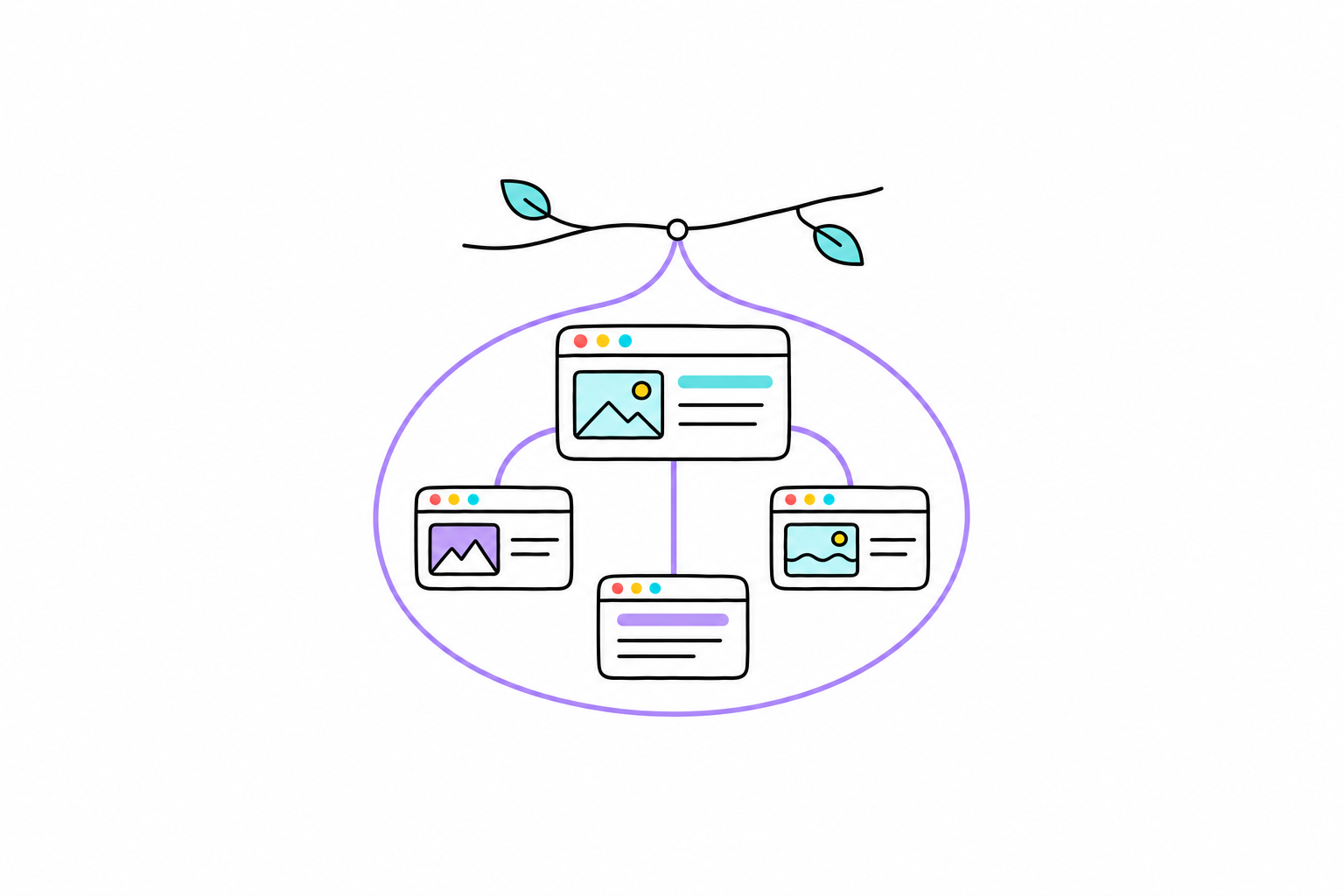
The semantic cocoon is an SEO method born in France, close to what English-speaking SEO consultants call topic clusters. The SEO consultants who apply it consider it decisive for ranking. Others have been asking since 2016 for proof that it works, and the published studies still offer none.
A cocoon groups the pages of one topic around a main page and connects them with links placed in the text. Google uses these links to find pages and assess their relevance, but no study has measured the effect of a cocoon on ranking. Its author, Laurent Bourrelly, adds two practices that Google classes as spam: websites created to get links, and links reserved for Google’s crawler.
Terms to know before you start
| Term | Meaning |
|---|---|
| Semantic cocoon | A way of organizing a website into groups of pages on one topic, connected by links in the text. The author of the method calls it “Topical Mesh” in English |
| Main page | The page that covers a topic as a whole; practitioners often call it the “mother page” |
| Detail page | A page that answers a specific question on the topic; it is also called a “daughter page” |
| Silo | An organization by sections in which the pages of a section only link to one another |
| External link (backlink) | A link from another website to yours |
| Topic-sensitive PageRank | A calculation published by a researcher in 2002: it measures the importance of a page from its links, topic by topic |
| Private blog network (PBN) | Websites created by the same person to link to their main website |
| Cloaking | Showing the crawler of a search engine a different page from the one shown to visitors |
Organize your pages into groups around a main page
SEO consultant Laurent Bourrelly presented the semantic cocoon in public at two conferences in 2013 on internal linking and website architecture6. In a recent text, he traces the idea back to the mid-2000s and sums it up in one phrase: a link is a statement, because it shows “who is related to what, and why”7.
In a cocoon, a main page covers the topic and detail pages each answer a specific question. Links placed in the text connect the pages that deal with the same thing. Each page of the group targets a different search.
In a 2020 video, Laurent Bourrelly sets his own rules. A mother page leads to daughter pages, and each of them leads to its granddaughters. Each page links to the one on the level above and to its sisters, but a granddaughter never links to the mother page4.
Laurent Bourrelly places the link that goes up one level at the start of the text, and gathers the links to the sisters in a list at the end of the page. He advises against attaching more than five daughter pages to the same page, and against creating a cocoon of fewer than thirty pages4.
We advise you to write the main page first, then the pages that answer the next questions of the reader. Link each of them to the main page with a link placed in a sentence on the same topic. Note each off-topic idea on a waiting list instead of adding it to the group.
When several ideas on this list meet the same need of the reader, gather them in a new group with its own main page.
One group per topic
A main page linked to four detail pages, which also link to one another.
A single link between two groups
From a detail page to the main page of the other group.
Waiting list
Off-topic ideas, kept for a future group.
Links from other websites
They point to the main pages.
Set aside the link schemes the author of the cocoon recommends
The method Laurent Bourrelly presented in June 2020, in a two-hour video, has twelve steps. Internal linking is only one of them, the sixth. Laurent Bourrelly then advises creating texts, images, videos and audio content. He recommends publishing them, then promoting them in the discussions devoted to the topic4.
On an existing website whose menus multiply links, he suggests showing Google’s crawler a link structure different from the one shown to visitors. He admits that this cloaking breaks Google’s guidelines, but considers it safe as long as the text of the pages doesn’t change. For a first try, he advises building the cocoon in a separate folder of the website instead4.
The eleventh step, presented as a bonus, is called “private link network”. In it, Laurent Bourrelly advises creating one small website a week by hand, about fifty in a year, without anyone being able to see that they belong to the same owner. For this, he recommends expired domain names. Each website contains links to the reference websites of the industry, plus a link to the main website4.
Laurent Bourrelly sets this “link wheel” apart from blog networks, which he finds crude, and presents it as the extension of the cocoon outside the website. He plans to remove these links if Google reports a penalty in Search Console4. In this version of his method, Laurent Bourrelly therefore adds to internal linking some links from websites created for the purpose.
Google’s rules define link spam as creating links to or from a website with the main purpose of manipulating rankings. Among the examples, Google lists excessive link exchanges and automated programs that create links to a website. The same rules class cloaking (showing search engines different content from what visitors see, to manipulate rankings) as spam5. Creating websites to get links seems ethically dubious to us, whatever name the practice is given.
These practices can work for a while. In July 2025, the French tech news outlet Next described a publisher of about 140 AI-generated websites. One of them had reached, in about two weeks, third place among the most visible websites on Google Discover (the personalized feed of articles from Google)8.
Google then penalized several of these websites, and the publisher immediately replaced them with others8. The article describes no links between these websites, but it shows the risk of such a bet. A publisher can replace a penalized website. A business already known by its name can hardly abandon its website that way.
Test the cocoon against studies on links and topics
According to Google, links let it discover new pages and assess their relevance. It advises linking a page to the other pages of the website that can help the reader understand it9.
The principle of the cocoon, connecting the pages of one topic, thus matches a piece of advice from Google. The studies published since 2001 make it possible to assess the rest of the method.
Pages on the same topic are often connected by links
In 2001, Filippo Menczer, of the University of Iowa, crawled 376,483 pages starting from 100 categories of the Yahoo directory. He measured that a page resembles the pages that cite it in its vocabulary, and that this resemblance fades as you move away from it, link after link1. As the links studied connected different websites, this measurement doesn’t support any conclusion about the internal linking of a website.

Experimental search engines rank better when they take the topic of links into account
In 2002, at Stanford University, Taher Haveliwala calculated sixteen PageRanks, one for each main topic of the ODP directory (Open Directory Project). On ten searches rated by five volunteers, the share of relevant results among the top ten rose from 28% to 51%, nearly double10.
Another experimental search engine, designed in 2001 at the University of Washington, gained 20 to 34% in relevance on nine searches11. These trials only cover a few searches, which isn’t enough to draw conclusions for a search engine like Google.
Laurent Bourrelly writes that he “soaked up” this topic-sensitive PageRank and presents it as “the founding document” of his thinking12. This calculation measures the importance of pages across the whole web in sixteen very broad topics, and has nothing to do with the way the pages of one website are connected. No source shows that Google applies topic-sensitive PageRank.
An internal link counts for less than a link from another website in an experimental search engine
In 2006, at Lehigh University, in the United States, three researchers assessed the two kinds of links separately in an experimental search engine. The engine gave the best results when an internal link carried ten times less weight than a link from another website. Without any internal links, however, the results of the engine got worse, because these links made up more than 80% of the links2.
Internal linking therefore matters, but it doesn’t replace links from other websites.
A link only helps the reader if they click it
In 2015, in the United States, researchers from Stanford University and the Wikimedia Foundation studied clicks on English Wikipedia: two thirds of the 800,000 links added in February had received no clicks in March. Adding more links to a page didn’t increase the total number of clicks: readers spread their attention across a larger number of links13.
The researchers then suggested links based on the real paths of visitors. Once Wikipedia editors had added them, the top 1,000 links ranked by this method received 95,000 clicks in March 201513. In our view, the real path of visitors is a better guide than a topic plan for deciding where to place a link.
Understand why a well-placed link would carry more weight
The so-called “reasonable surfer” patent was filed for Google in June 2004 by Jeffrey Dean, Corin Anderson and Alexis Battle. Granted on May 11, 2010, it has since expired3.
This imaginary surfer chooses some links more readily than others. The patent describes a calculation that gives each link a weight based on the probability that a reader clicks it3.
The criteria described in the patent include the position of the link, the size of its characters and its text. According to this document, a link near the top of the page is more likely to be chosen. The calculation even includes the links nobody chooses, as examples of ignored links3.
Laurent Bourrelly claims, like other practitioners, that when a page has two links to the same URL, only the first one counts4. We think, on the contrary, that Google records each link on a page and gives it a weight that depends on its chances of being clicked.
A patent describes an invention without proving that Google uses it. Nor does the expiry of this patent prove that Google has stopped using it, so we present this reading as an opinion.
In a cocoon as elsewhere, place the link to the main page in the text, early in the page, in the middle of a sentence about its topic. A footer link also connects the pages, but a reader is less likely to notice it.
“bike trip along the Loire”
A link in a paragraph, with a good chance of being clicked.
High weight
“Loire” in the footer
A link in small print, with little chance of being clicked.
Low weight
Weigh the evidence put forward for the cocoon
No published study has examined the effect of a cocoon, a silo or a topic group of pages on ranking in Google. The closest test comes from SearchPilot, a company that sells SEO tests: in 2021, on a content website, traffic from search engines rose by 11% when pages went from two to four links to related articles14.
SearchPilot, however, only gave this gain a 90% chance of being real, below the usual 95% threshold. No measurable effect was observed on the pages the new links pointed to14.
In this test, SearchPilot added blocks of links without comparing a website organized as a cocoon with a website that isn’t. The result therefore doesn’t support any conclusion about the cocoon itself.
In the field, the websites cited as examples often changed something else at the same time as their linking. In a typical case, a website presented as a cocoon success was receiving, at the same moment, the redirect of a heavily cited domain and links from thousands of other websites.
The test that would settle the matter between supporters and skeptics, on a stable website with a cocoon and no extra links at all, has been called for since 2016 and has never been published. Without this test, the effect of the cocoon on ranking can only be a hypothesis.
Finally, Google says it generally shows no more than two pages from the same website among its top results15. In our view, two pages on related topics don’t harm each other for all that. Two pages that give the same answer to the same search, on the other hand, may compete for these two places.
Example: a bike tour agency
For this example, we imagined a bike tour agency based in Tours, France, whose forty pages were published without a plan.
The agency groups its pages around the Loire Valley by bike
The manager chooses “The Loire Valley by bike in one week” as the main page. Four detail pages answer the questions of the agency’s customers: the stages, e-bike rental, family trips and luggage transfer. Each one contains a link to the main page from its first paragraph, plus a link to another detail page when the text touches on its topic.
The agency puts its off-topic ideas on a waiting list
The manager finds no place in the group for an article on cycling in Iceland and notes it on the waiting list. Six months later, three ideas on the list concern Brittany. The manager turns them into a second group around a main page, “Brittany by bike”.
The agency turns down satellite websites
A provider offers to “strengthen the cocoon” with ten small websites about cycling that would each link to the website of the agency. The manager says no, and suggests to the tourist office, whose website also addresses families, a link to her page on family trips.
After eight weeks, the manager sees in Google Search Console that the main page appears for “loire valley by bike 7 days”. Nothing guaranteed this result. The link from the tourist office doesn’t show in the Links report yet.
You’re done when…
Each topic of your website has its main page, and the pages that detail it cite that page in their text. You note off-topic ideas on a list instead of adding them to an unrelated group.
When you assess a cocoon method, tell apart measured observations, lab experiments and promises with no data to back them.
If it doesn’t work
If a main page doesn’t appear for any search on its topic, first check that no detail page targets the same search. Google may be showing two of your pages in turn for the same search. The page “What should I do when two of my pages compete for the same search?” presents the solutions.
The pages of a cocoon can stay far behind those of competitors that receive external links, even if their internal links are carefully made. The page “How do I get links when my website has almost none?” presents ways to get these links without breaking Google’s rules.
Keep the discipline of the cocoon that helps readers
The cocoon leads you to organize your website by topic and to place links in clear sentences. This discipline helps your readers first, whatever the results of future studies on Google. Building websites to get links or reserving links for Google’s crawler, on the other hand, exposes your website to a penalty.
Careful internal linking has no effect if Google can’t crawl your pages. The next chapter presents the technical problems that prevent this crawling, and how to fix them.
Previous chapter: Structure a website with thousands of pages
Next chapter: Fix technical SEO problems
Sources
- ↑ Filippo Menczer, “Links tell us about lexical and semantic Web content“, University of Iowa, arXiv preprint cs/0108004, August 8, 2001; revised version: Journal of the American Society for Information Science and Technology, vol. 55, no. 14, 2004.
- ↑ Lan Nie, Brian D. Davison and Xiaoguang Qi, “Topical Link Analysis for Web Search“, SIGIR 2006 conference, Lehigh University, section on the weight of links internal to a domain.
- ↑ Jeffrey A. Dean, Corin Anderson and Alexis Battle (Google), “Ranking documents based on user behavior and/or feature data“, US patent US7716225B1, filed June 17, 2004, granted May 11, 2010, expired, Google Patents, accessed November 16, 2026.
- ↑ Laurent Bourrelly, “Semantic SEO in 10 Steps with the Topical Mesh Strategy“, SEO Conspiracy YouTube channel, June 10, 2020 (Paris time), video description (steps 6, 10 and 11) and video: linking rules at about 1:16:00, cloaking at about 1:26:00, private link network at about 1:53:00.
- ↑ Google, “Spam policies for Google web search“, Google Search Central, sections on cloaking and on link spam, accessed November 16, 2026.
- ↑ Laurent Bourrelly, “À propos” [About], author’s website, list of conferences in 2012 and 2013, accessed November 16, 2026.
- ↑ Laurent Bourrelly, “Le SEO n’est pas difficile. Il est mal compris” [SEO isn’t hard. It’s misunderstood], author’s blog, undated (2026 according to the page), accessed November 16, 2026.
- ↑ Jean-Marc Manach, “Éditeur de sites générés par IA, il spamme tellement Google que ses confrères se plaignent” [A publisher of AI-generated websites spams Google so much that his peers complain], Next, July 11, 2025.
- ↑ Google, “SEO link best practices for Google“, Google Search Central, accessed November 16, 2026.
- ↑ Taher H. Haveliwala, “Topic-Sensitive PageRank“, WWW 2002 conference, Stanford University, section on the user study.
- ↑ Matthew Richardson and Pedro Domingos, “The Intelligent Surfer: Probabilistic Combination of Link and Content Information in PageRank“, NIPS 2001 conference, University of Washington, section on results.
- ↑ Laurent Bourrelly, “Respirez le mot clef et autres considérations sur le cocon sémantique” [Breathe the keyword, and other thoughts on the semantic cocoon], author’s blog, undated (around 2016 according to the text), accessed November 16, 2026.
- ↑ Ashwin Paranjape, Robert West, Leila Zia and Jure Leskovec, “Improving Website Hyperlink Structure Using Server Logs“, WSDM 2016 conference, Stanford University and Wikimedia Foundation, sections 1, 5 and 6 (links added in February 2015, clicks in March 2015).
- ↑ SearchPilot, “Will increasing the number of related article links help for SEO?“, case study, June 10, 2021.
- ↑ Google, “A guide to Google Search ranking systems“, Google Search Central, section on the site diversity system, accessed November 16, 2026.